
The 90-Hour Cliff: Why New Brokers Quit Before Their First Renewal (And How Smart Firms Prevent It)
Bringing a newly licensed Broker into your Washington State real estate firm is an exciting investment. You spend hours recruiting candidates, integrating them into your culture, training them on your technology, and building their marketing materials. For the first twelve to eighteen months, they learn the ropes and ideally close their first few deals.
Then month eighteen arrives, and a stark reality sets in. The Department of Licensing first-renewal requirements begin looming on the horizon. To maintain an active license, your new Broker must complete 90 hours of specific post-licensing continuing education. For many newly minted Brokers, this requirement does not feel like a professional milestone. It feels like an insurmountable cliff.
Faced with a daunting educational burden, significant financial constraints, and the pressure of building a business from scratch, a staggering number of Brokers simply surrender their licenses. They walk away right as they are poised to become profitable. For firm owners and Managing Brokers, this represents a devastating loss of investment, time, and future revenue. The most successful firms in Washington view this not as an inevitable industry standard, but as a solvable operational challenge.
What follows is a comprehensive look at why the 90-hour first-renewal requirement is the single greatest attrition trigger for new Washington Brokers, the hidden costs of losing them, and the strategic return on investment of transforming this compliance hurdle into a powerful retention tool.
The Anatomy of the 90-Hour First-Renewal Burden
To understand why Brokers quit, Managing Brokers must first look objectively at what Washington State demands of a first-renewal licensee. Under state continuing education mandates, a Broker renewing their active license for the first time must complete 90 hours of approved education. The state dictates the strict composition of those hours:
- 30 hours of Advanced Real Estate Practices
- 30 hours of Real Estate Law
- 3 hours of current Washington Real Estate CORE
- 27+ hours of approved elective continuing education
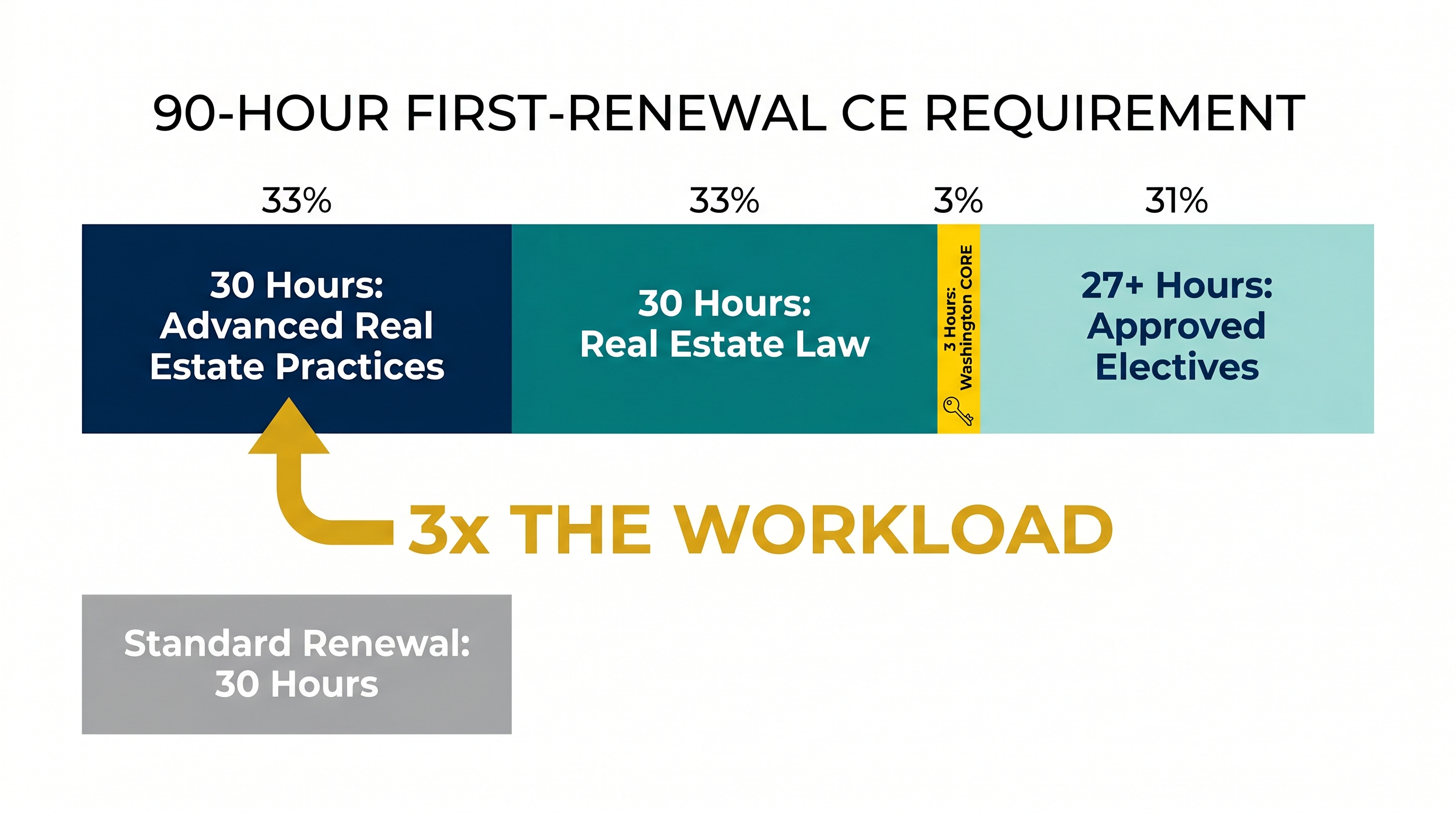
Washington's first-renewal requirement demands 3x the education of every subsequent renewal cycle—at the worst possible time in a new Broker's career.
The sheer volume of this requirement becomes uniquely punishing when contrasted with the standard 30-hour requirement for all subsequent two-year renewal cycles. A new Broker is essentially tasked with completing three times the educational workload of a seasoned veteran at precisely the moment in their career when they possess the least discretionary time and income.
If a new Broker fails to complete these 90 hours before their expiration date, the consequences are immediate and operationally costly. The license expires and falls into canceled or inactive status, meaning the Broker legally cannot earn commissions, write contracts, or represent clients. Reinstating a canceled license carries steep penalties: a $233 renewal fee, a $100 reinstatement fee, and a $273 late fee. For Managing Brokers maintaining compliance calendars, these operational interruptions and the resulting hundreds of dollars in out-of-pocket penalties make tracking continuing education progress an absolute necessity.
The Financial Reality of the First Two Years
Why does 90 hours feel so heavy? Because it aligns perfectly with the financial trough of a real estate career. According to the 2025 NAR Member Profile, the median gross income for agents with two years or less of experience is just $8,100.
When a Broker is earning roughly $8,000 annually, every dollar is scrutinized. They are already paying MLS dues, association fees, marketing costs, and lockbox subscriptions. Layering on the cost of a 90-hour education package, which can range from hundreds to over a thousand dollars depending on the provider, along with the time taken away from lead generation to complete coursework, makes the financial strain critical.
Many Brokers run the numbers at month eighteen, weigh the cost and time required against their current income, and decide the math simply does not work in their favor. That calculation drives the cliff.
The Hidden Costs of the "Churn and Burn" Cycle
When a Broker quits before their first renewal, the financial impact ripples directly to the firm's bottom line. Washington State law lacks structural "stickiness" since Brokers can only be licensed to one firm at a time, but they can sever that affiliation with remarkable ease. As a result, a firm's retention strategy must be built on tangible value, not contractual obligation.
When the 90-hour cliff pushes new Brokers out of the industry, your firm absorbs several hidden, compounding costs:
1. The Sunk Costs of Recruiting and Onboarding
Every Broker in your office represents an acquisition cost. You spent time recruiting, interviewing, setting up desk arrangements, integrating them into your CRM, and walking them through your firm's specific protocols. When they leave at month twenty-four, that entire investment yields zero long-term return.
2. The Loss of Maturing Production
Real estate is a compounding business. A Broker's first two years are spent building a database, learning to communicate with buyers and sellers, and navigating their initial escrows. By year three, they typically begin generating referrals and repeat business. When a Broker quits at first renewal, the firm loses them at precisely the moment their production and your commission split was about to escalate.
3. The Heightened Supervision Restart Trap
Under state law, Managing Brokers and designated brokers are legally required to provide a heightened level of supervision for all Brokers during their first two years of licensure. This means your management team is spending significant hours reviewing every contract, addendum, and listing agreement a new Broker drafts.
This mandatory supervision is a substantial drain on operational efficiency. Once a Broker completes their two years, they graduate from heightened supervision, freeing up meaningful Managing Broker time. However, when that Broker quits and is replaced with a new recruit, the two-year supervision clock resets entirely. Your management team becomes permanently trapped in a cycle of supervising novices rather than collaborating with seasoned top producers.
Building the ROI Model for Education Subsidies
The business case for intervening becomes clear through a straightforward Return on Investment equation:
Value of Retained Broker = (Avoided Recruiting Costs) + (Avoided Onboarding/Supervision Hours × Managing Broker Hourly Rate) + (Preserved Year-3 Production Splits)
Consider a realistic illustrative calculation for a typical Washington firm. Losing a Broker forfeits your initial onboarding investment. For example, 40 hours of recruiting and integration at a $50/hour Managing Broker rate equals $2,000. Replacing that Broker resets the heightened supervision period. At 5 hours of extra review per month over 24 months, that adds 120 hours, or $6,000 in lost management time. Finally, assuming a conservative year-three Gross Commission Income where the firm's retained split equals $10,000, the total financial impact reaches $18,000 in preserved value.
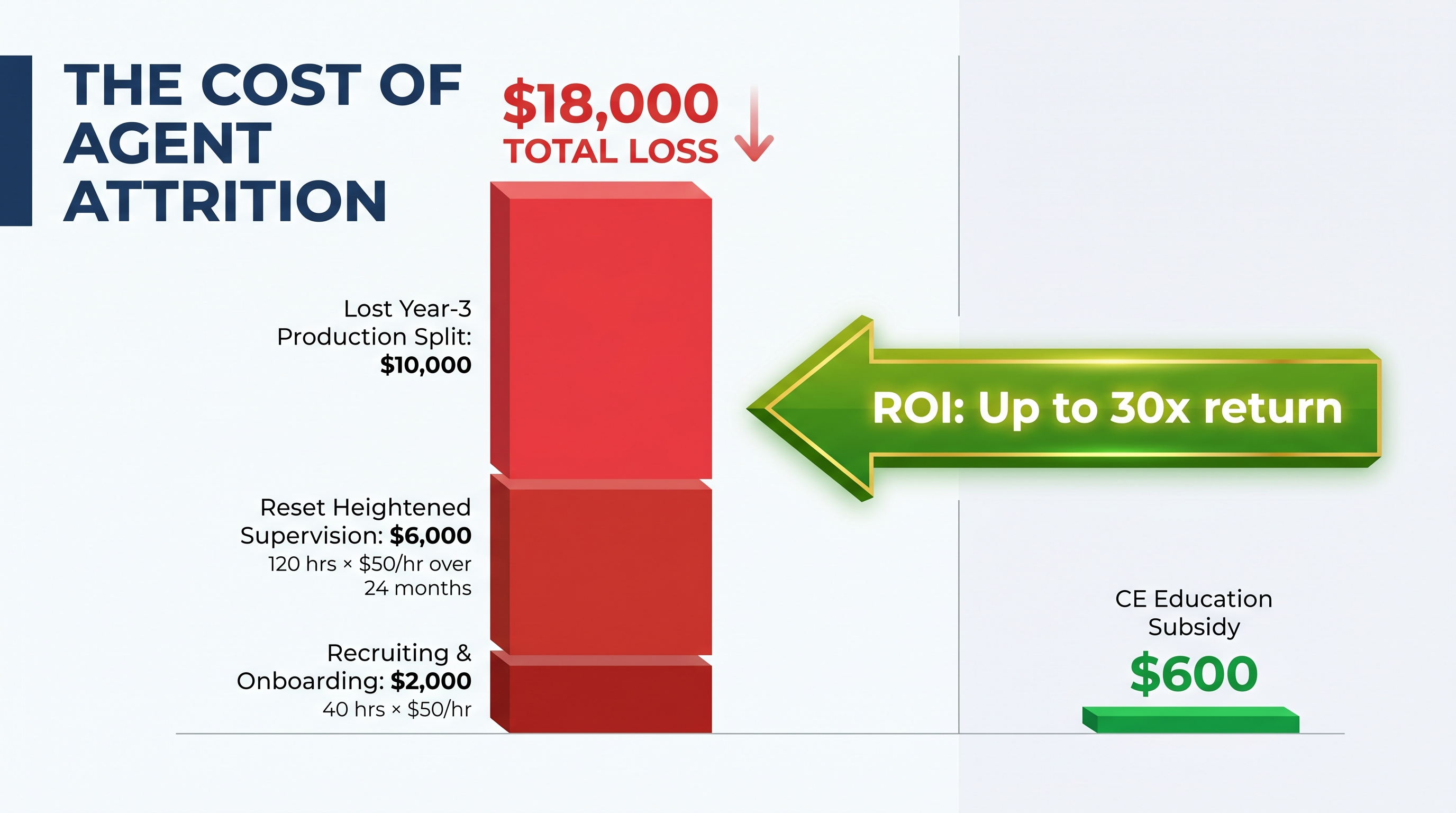
The math is clear: subsidizing a Broker's first-renewal education is one of the highest-return investments a firm owner can make.
Comparing that $18,000 in retained value against the few hundred dollars it costs to subsidize or co-manage a Broker's 90-hour first-renewal education reveals one of the highest-return investments a firm owner can make.
How Smart Firms Transform Education into Retention
The most successful real estate firms in Washington do not passively wait for their Brokers to manage their own continuing education. They actively integrate the 90-hour requirement into their retention and firm-culture strategies, treating education as a value proposition rather than a box to check for the state.
Here is how industry-leading Managing Brokers are changing the narrative:
Creating a "First 24 Months" Pathway
Rather than allowing 90 hours to loom as an intimidating deadline at the end of year two, smart firms break the requirement into a manageable, 24-month roadmap. They integrate the 30-hour Advanced Practices course into the Broker's first six months, when practical transaction knowledge is most immediately useful. The 30-hour Real Estate Law course is scheduled for year two, layered with in-house legal risk management training.
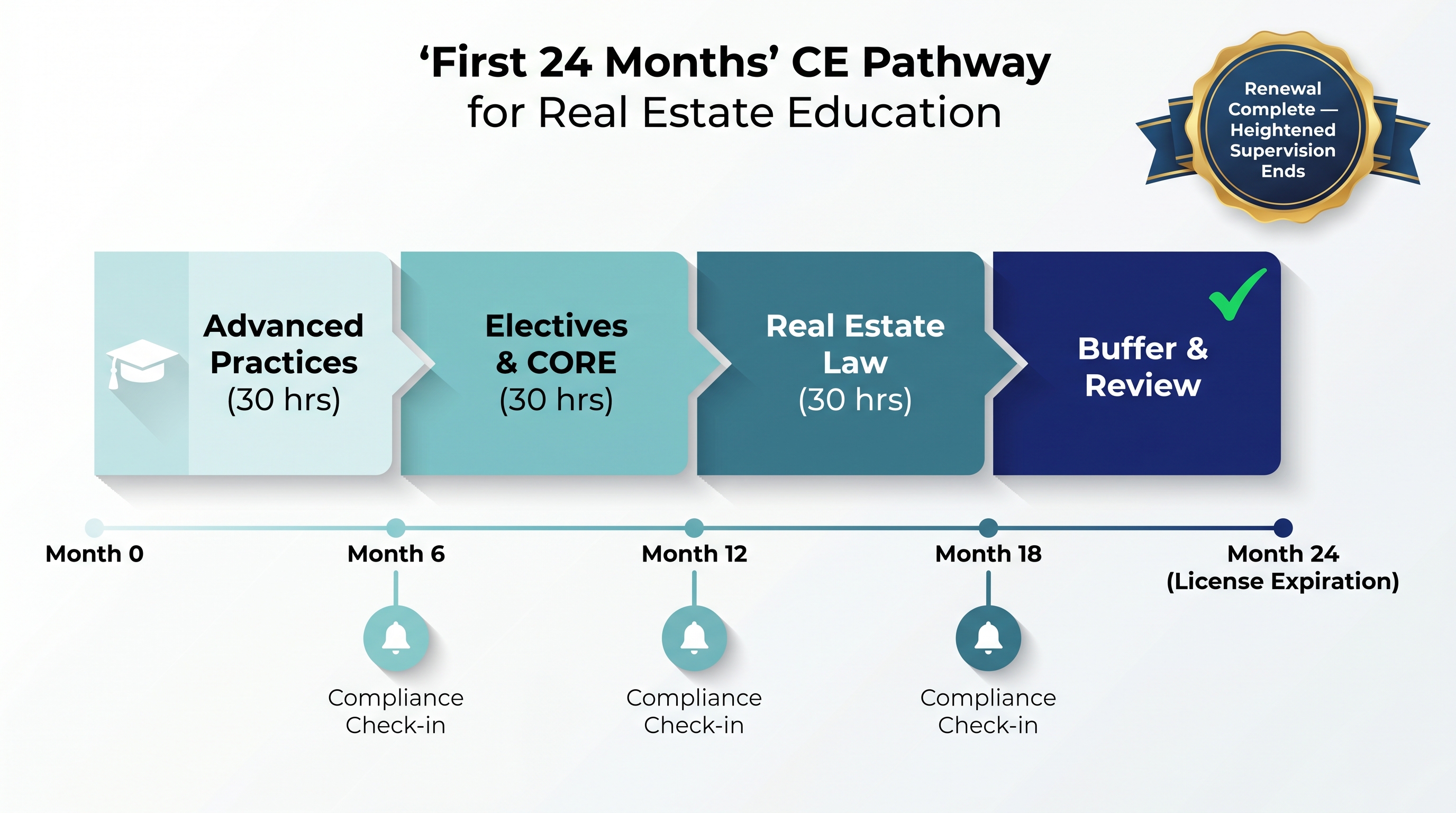
A structured 24-month CE roadmap turns an overwhelming 90-hour requirement into manageable quarterly milestones—with built-in compliance check-ins.
Subsidizing and Co-Managing CE
Financial support is the most direct proof of partnership. Many firms now offer to subsidize the cost of the first-renewal package by paying for it outright, splitting the cost, or reimbursing the Broker from their next closed transaction. This approach immediately relieves the financial pressure that drives so many new licensees out of the industry.
Implementing Compliance Calendars
Top-performing firms use their CRM or internal management software to track Broker licensure dates, setting automated 6-month, 12-month, and 18-month check-ins specifically focused on education progress. This proactive approach ensures no one is scrambling to complete 90 hours in the final weeks before expiration.
These strategies align with national trends. According to the 2025 NAR Profile of Real Estate Firms, 71% of real estate firms actively encourage their agents to pursue certifications, and 61% provide or encourage ongoing training. Newer Brokers consistently report that structured training and actionable leads are the two primary things they seek from their brokerages. By wrapping firm support around the mandatory 90-hour requirement, you deliver exactly what they want while securing their long-term loyalty.
The "Build vs. Buy" Dilemma: The Pitfalls of In-House Schools
Recognizing the value of providing education, some firm owners consider becoming an approved real estate school to train their Brokers in-house. While the intent is sound, the execution carries a significant administrative burden.
Under Washington law, establishing a school requires securing separate approvals for the institution, its instructors, and each individual course. Because course reviews typically take 30 to 60 days per state guidance, curricula cannot pivot quickly to reflect changing market dynamics. Mandatory two-year renewal cycles and constant state compliance updates add further ongoing obligations. Diverting management bandwidth to maintain a heavily regulated educational institution ultimately distracts from your primary business of supporting your Brokers and selling real estate.
The Strategic Solution: Partnering with realestateschool.org
Before committing to any education provider, firm owners should evaluate schools against core criteria: current state approval status, flexibility of course delivery like self-paced mobile options, and the availability of bulk or partner pricing. This due diligence ensures the chosen education meets both regulatory requirements and your firm's operational needs.
This is where realestateschool.org provides an unparalleled solution for Washington real estate firms.
By partnering with realestateschool.org, your firm can offer a streamlined, white-glove educational experience to your newer Brokers. We provide comprehensive First Renewal packages that fulfill the full 90-hour requirement, including the 30-hour Advanced Practices course, the 30-hour Real Estate Law course, and the fully up-to-date 2026–2027 CORE curriculum.
Our platform eliminates the guesswork, allowing your Brokers to log in, follow a clearly structured pathway, and complete their hours at a pace that fits their active business schedules.
For firm owners and Managing Brokers, our Partner Pricing model allows you to subsidize or fully fund your Brokers' education at an exclusive, cost-effective rate. You can use our premium educational platform as a recruiting and retention tool, offering incoming Brokers a guaranteed, paid pathway through their most difficult compliance hurdle without filing a single course approval application with the state.
Stop Losing Brokers to the 90-Hour Cliff
Your firm invests too much time, energy, and capital into recruiting and training new Washington Brokers to lose them to a predictable, manageable compliance requirement. The 90-hour cliff does not have to be a point of departure. It can be a bridge to long-term retention, loyalty, and mutual profitability.
Protect your investment and keep your best new talent in production. Contact realestateschool.org today to learn more about our Partner Pricing programs and how we can build a First Renewal educational pathway tailored to your brokerage.
Like this? Become a Marketing Partner.
Marketing Partners co-brand and syndicate this content to their team, get discounted courses for their agents, and earn commissions on referrals.
Sign up →