
The End of Exclusionary Marketing: Navigating Washington's Concurrent Public Marketing Mandate
On June 11, 2026, Washington State fundamentally changes residential real estate marketing. The new law is a strict operational requirement for every firm. For Designated Brokers, Managing Brokers, and firm owners, the margin for error is gone. If your brokers still use "coming soon" whisper campaigns, send office-exclusive emails, or share listings in private networks, your firm faces serious regulatory exposure. This guide helps you understand the legal mandate, update office policies, and retrain your team before the Department of Licensing begins active enforcement.
What the New Law Actually Does
The legislation prohibits marketing residential real estate to a limited or private group without concurrently marketing the property to the general public and all other licensed brokers. This creates a strict concurrent public marketing mandate. If a broker tells a single person outside your brokerage about a property, it must be simultaneously available to the general public.
Marketing exclusively on your brokerage website does not satisfy this requirement. General public marketing means broad submission to an active Multiple Listing Service or comparable public platform. The law explicitly covers both the sale and lease of residential real estate. Property managers face the exact same exposure. Exclusively marketing residential rentals to a closed list of prospective tenants carries identical regulatory liability.
The Health and Safety Exception
There is exactly one legal exception. You can limit exposure only when strictly required for the health or safety of the owner or occupant. Qualifying circumstances require concrete documentation, such as an active domestic violence protective order, a documented stalking case, or a medical fragility situation requiring zero physical disruption. Non-qualifying circumstances include a seller's general preference for privacy, celebrity status, or a desire to test the market. Regulators will view anything less than a documented health or safety risk as a willful violation of state law.
What Must Stop Immediately
Managing Brokers must immediately dismantle non-compliant systems. The following practices are no longer allowed as of June 11:
- Pocket Listings and Whisper Campaigns: Casually mentioning upcoming listings at networking events, pitching properties to preferred investors, or testing the market without concurrent public marketing is strictly prohibited.
- VIP Buyer Lists and Office-Exclusive Emails: Sending an exclusive first look to a curated list of buyers or past clients directly violates the concurrent marketing requirement.
- Private Broker Networks: Utilizing invite-only Facebook groups, restricted WhatsApp chats, closed Slack channels, or private networking platforms to pre-market properties is now illegal.
- New Construction VIP Programs: This mandate applies equally to new construction pre-sale or reservation programs. Builders cannot release off-market phase reservations to preferred buyers without simultaneously opening those reservations to the broader market.
- Seller Preference Exemptions: Previously, a seller could sign a waiver requesting an office-exclusive listing. Under the new law, seller preference alone is no longer a valid exception.
Enforcement and Penalties
The Department of Licensing is authorized to impose fines up to five thousand dollars per violation. Financial penalties represent only the beginning. Available sanctions include license revocation, suspension, practice restrictions, mandatory remedial education, compliance monitoring, formal censure, probation, and the denial of future applications. A single broker attempting to secure both sides of a transaction through exclusionary marketing can trigger an investigation into your entire firm.
When a broker violates this law, regulators will look up the chain of command. Designated Brokers bear the ultimate legal responsibility for all brokerage activities. State regulations explicitly mandate that Managing Brokers and Designated Brokers actively supervise the conduct and marketing practices of their affiliated brokers. A failure to formally train your team or update your office policy manual will be viewed as a failure to supervise, exposing the firm to joint disciplinary action.
Why Washington Law Trumps National Policies
When retraining brokers, you will likely encounter resistance based on national headlines. You must dispel confusion surrounding national policies. In March 2025, the National Association of REALTORS retained its Clear Cooperation Policy but introduced Multiple Listing Options for Sellers. Meanwhile, the Northwest Multiple Listing Service had already declined to adopt exclusionary rules.
Broker-leaders must train their teams to understand the legal hierarchy governing real estate practice. Washington State Statute overrides Department of Licensing Regulations, which override MLS Rules, which override National Association Policy.
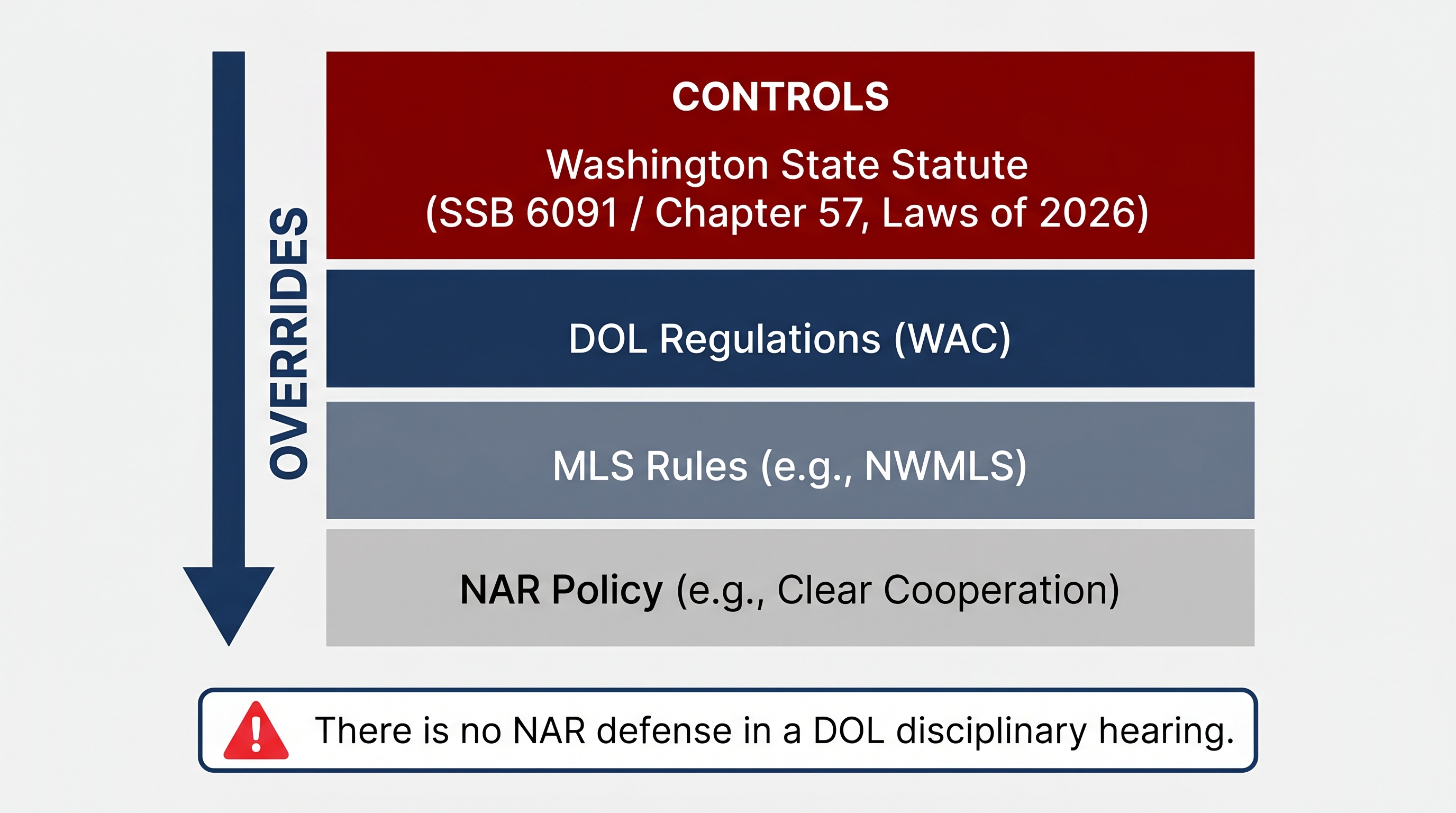
The Legal Hierarchy Governing Washington Real Estate Practice: State statute always controls.
Regardless of what national policies permit, Washington state law prohibits exclusionary marketing. State legislative statute overrides all association policies, board guidelines, and MLS rules. If a broker relies on a national association's leniency to justify an office-exclusive listing, that broker is directly violating Washington state law. There is no national association defense in a state disciplinary hearing.
Transitioning Existing Listings
For listings already under an exclusive or non-compliant pocket arrangement, Managing Brokers must act before the June 11 effective date. Sellers must be formally notified of the legal change, and existing listing agreements must be amended. Brokers must transition these listings to fully compliant public marketing channels on June 11 or pause active marketing entirely.
To ensure complete consumer transparency, the state has amended the Law of Real Estate Agency Pamphlet to include a specific, bolded section stating that property must be marketed publicly. Brokers must provide this newly updated pamphlet to clients and clearly explain that public marketing is a non-negotiable legal requirement.
What Sellers Can Still Control
Public marketing does not mean sacrificing all seller control. Sellers can still take specific steps to protect their privacy, provided the listing is concurrently marketed to the public.
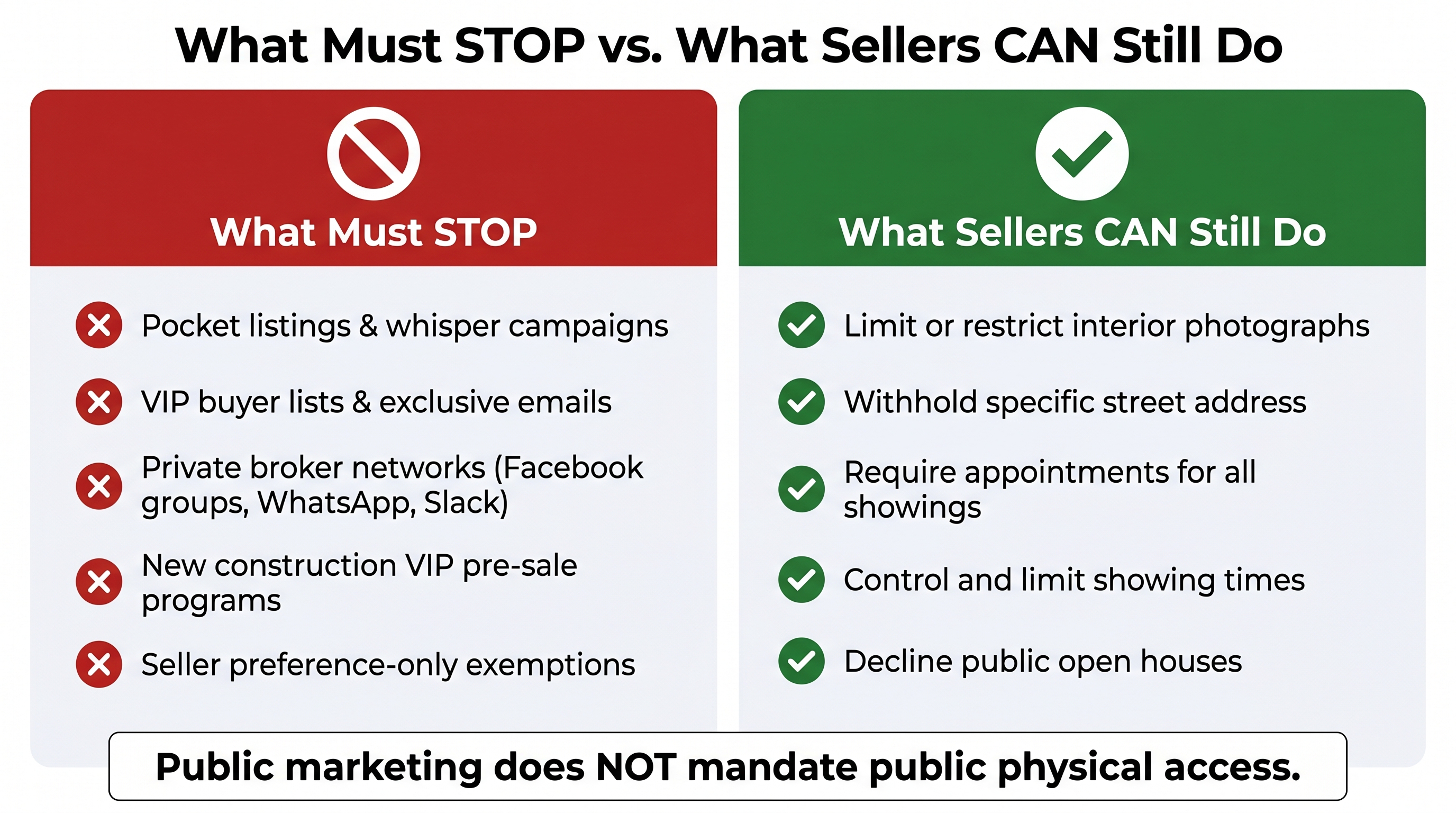
Prohibited vs. Permitted: What changes and what sellers can still control under SSB 6091.
- Limit or restrict interior photographs: A public listing does not require a full 3D tour of the seller's home.
- Withhold the display of the property's specific street address: The listing can be public without broadcasting the exact location to internet portals.
- Require appointments for all showings: Sellers can demand pre-approval letters and require advance notice.
- Strictly control and limit showing times: The property can be publicly marketed even if showings are available only on designated days and within specific hours.
- Decline to host public open houses: Public marketing does not require opening the front door to unvetted foot traffic.
Public marketing does not mandate public physical access. Training your brokers to articulate this distinction clearly will preserve listings when working with privacy-conscious sellers.
The Actionable Compliance Checklist
You have until June 11, 2026. Execute the following steps immediately to protect your firm and your license.
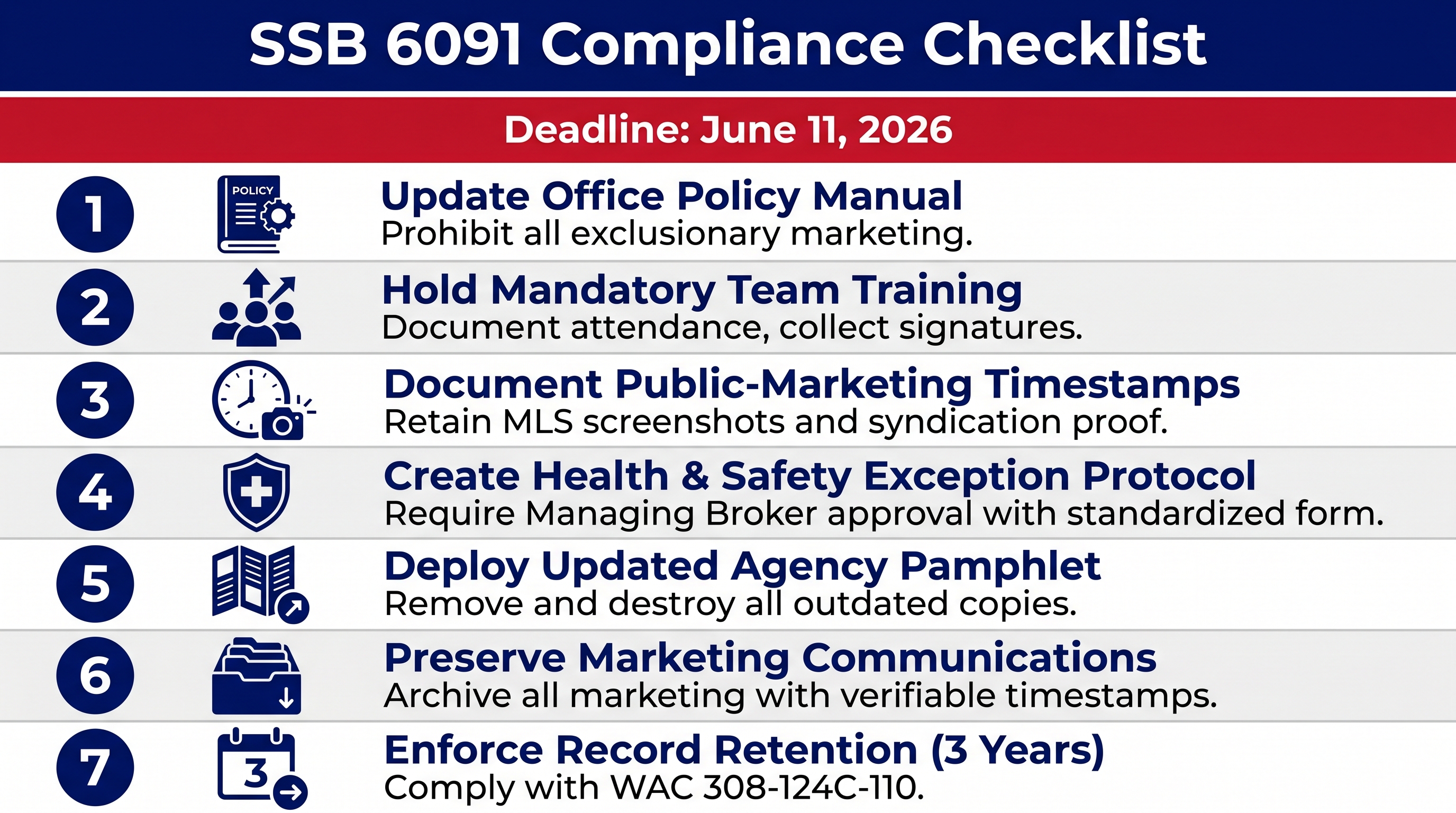
The Broker-Leader's SSB 6091 Compliance Checklist: Execute all seven steps before June 11, 2026.
- Update Your Office Policy Manual: Explicitly prohibit all forms of exclusionary marketing, VIP buyer lists, private networking groups, and pocket listings.
- Hold a Mandatory Team Training Meeting: Require attendance from all affiliated brokers. Document who attended and collect signatures acknowledging the new policy.
- Document Public-Marketing Timestamps: Establish a firm-wide protocol requiring brokers to retain timestamped proof, such as MLS active status screenshots, demonstrating that public marketing occurred concurrently with any direct marketing.
- Create a Strict Health and Safety Exception Protocol: Draft a standardized internal form for the rare instances where the health or safety exception genuinely applies. Require Managing Broker or Designated Broker review and approval.
- Deploy the Updated Pamphlet: Ensure all brokers have downloaded the newly updated Law of Real Estate Agency Pamphlet. Mandate the removal of all outdated physical copies.
- Preserve Screenshots and Communications: Implement a standardized system to archive marketing communications, providing verifiable proof that concurrent public marketing was executed.
- Enforce Strict Record Retention: Ensure all documentation related to listing strategies, client instructions, health or safety exceptions, and marketing timelines is retained for three years, in compliance with state record retention rules.
Retraining Your Team
Internal meetings and updated manuals are essential, but they are not sufficient on their own. The mandatory CORE 2026 to 2027 curriculum, effective January 1, 2026, is a state-prescribed, three-hour required continuing education course. It is one of the most critical tools available for compliance.
State regulations require real estate course materials to be updated no later than 30 days after the effective date of a change in state statutes or rules. Approved CORE courses now fully integrate the June 11 listing mandates. Firm owners and Designated Brokers are strongly encouraged to arrange bulk enrollment for their entire rosters without delay.
We also recommend supplementing this required education with elective training. Advanced training equips brokers with the tactical guidance needed to navigate complex seller objections, apply the health or safety exception correctly, and operate confidently within the new compliance framework.
The era of the whisper campaign is over. June 11, 2026, represents a fundamental shift in Washington real estate, moving the industry toward full marketing transparency. Update your policies, retrain your brokers, and supervise your marketing channels with consistent, disciplined vigilance.
Like this? Become a Marketing Partner.
Marketing Partners co-brand and syndicate this content to their team, get discounted courses for their agents, and earn commissions on referrals.
Sign up →